Professional teams in schools and organisations operate in increasingly complex environments, balancing performance expectations, relational efforts, accountability, and continuous change. Differences in working modalities, communication, pacing, and decision-making are often implicit and rarely named. When these differences remain unexamined, they are easily personalised, leading to tension, misattribution, disengagement, or burnout.
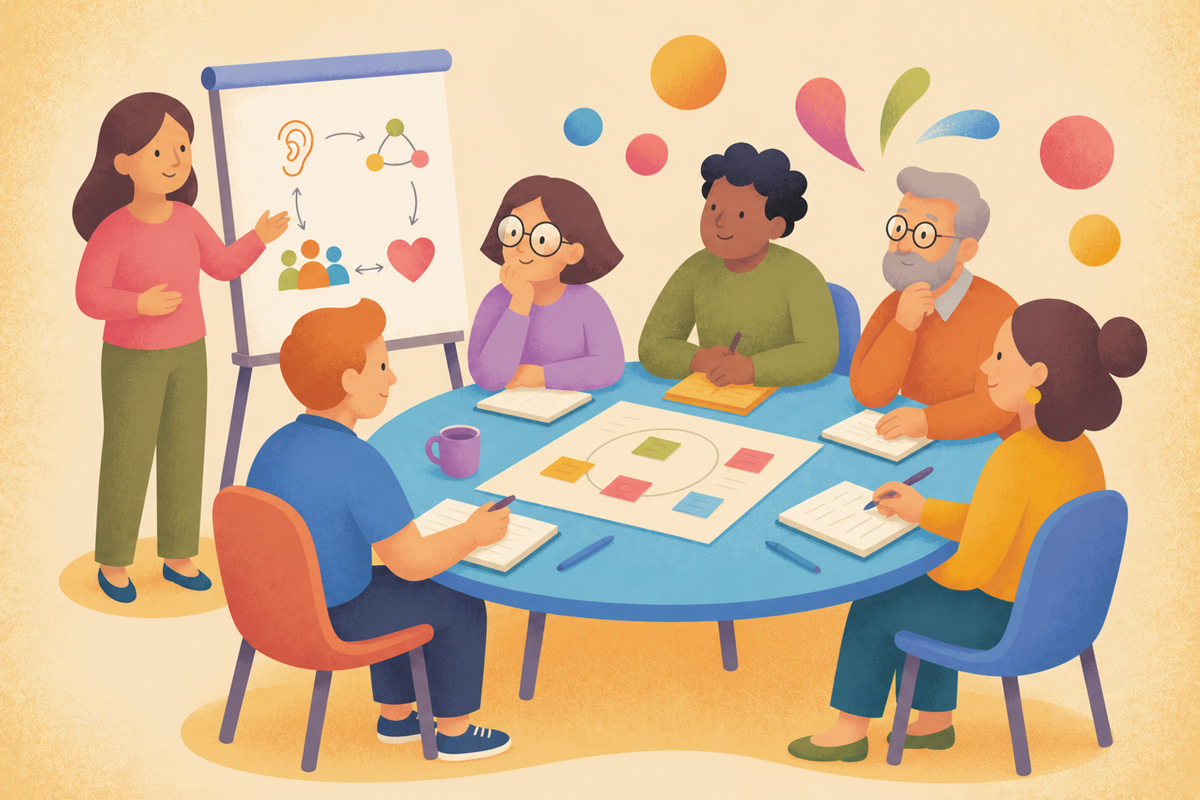
Inner Diversity at Work supports teams to recognise and work with diverse ways of sense-making and collaboration. Through deliberate practice of core capacities, such as observing, discerning patterns, active listening, reflecting, and regulating under pressure (relaxing), teams develop the ability to interpret challenges more accurately and respond more constructively. This strengthens professional relationships, psychological safety, and organisational coherence, while supporting both effectiveness and well-being.
The training focuses on team dynamics, communication, and professional culture. Teams develop a shared, neutral language to interpret challenges systemically rather than personally. Emphasis is placed on building collective capacity for reflection, dialogue, and adaptive action in everyday professional contexts.
Understanding inner diversity at work
Participants explore how differences in sense-making, pacing, and approaches to working shape collaboration and misunderstanding. Through observing patterns and reflecting together, teams learn to distinguish personal preferences from structural or relational mismatches.
Relational quality in teams
The programme strengthens listening, empathising, and feedback (reflecting) practices that support psychological safety. Teams examine how relational quality directly affects coordination, learning, decision-making, and the capacity to navigate pressure and uncertainty.
From tension to insight
Recurring tensions and conflicts are approached as signals rather than failures. Participants practice inquiry and collective reflection to uncover underlying dynamics, enabling more precise and less reactive responses.
Shared responsibility and professional agency
Teams reflect on how responsibility is distributed, taken up, or avoided. By strengthening clarity, mutual accountability, and discernment, participants develop a stronger sense of professional agency and ownership.
Embedding inclusive professional practices
Awareness of inner diversity and core capacities is integrated into meetings, supervision, decision-making, and daily routines. This supports sustainable collaboration and alignment between well-being, values, and organisational goals.
Participants will learn to: