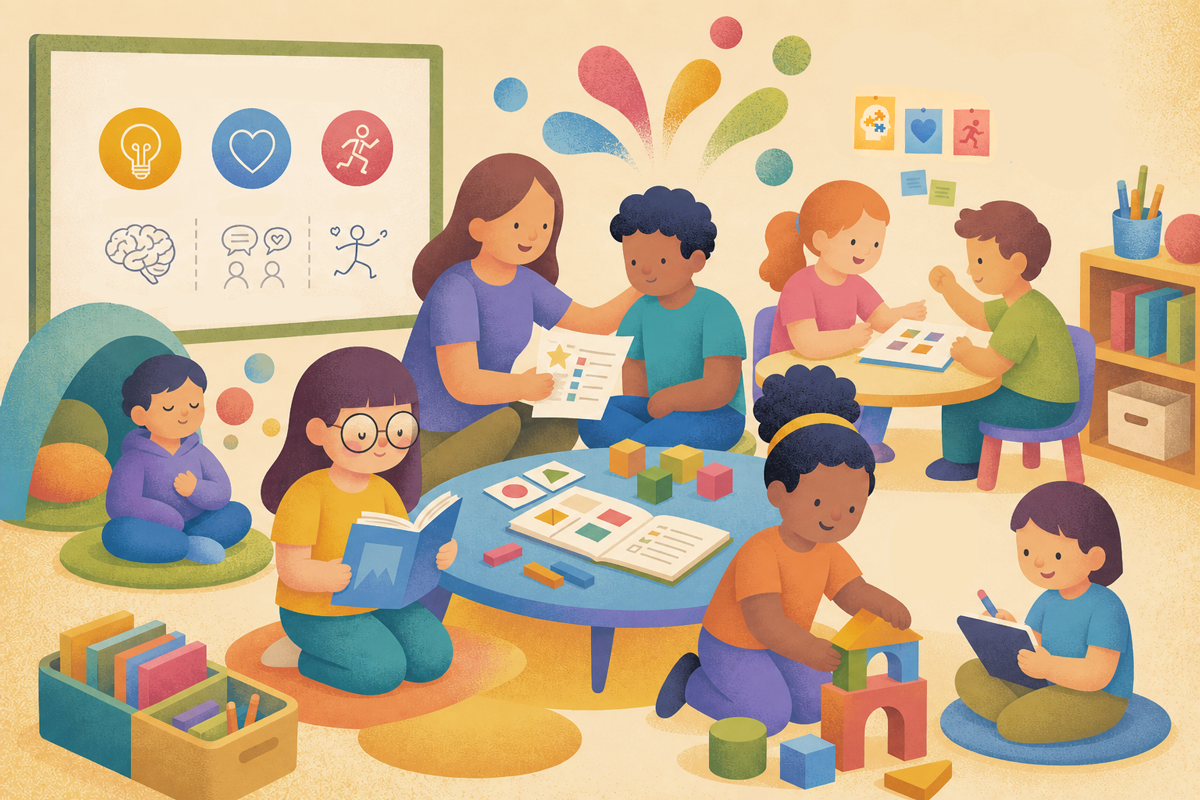
Classrooms today bring together a wide diversity of learning needs, socio-economic backgrounds, and emotional realities. Students differ not only in prior knowledge, but in how they pay attention, process information, regulate emotions, and demonstrate understanding. When these differences are not recognised, learning patterns can be seen as disruptive behaviour, and difficulties are often misinterpreted as lack of ability, effort, or motivation.
TriDimensional Teaching addresses this challenge by supporting teachers to work with how learning happens, not only with what is taught. Drawing on research in didactic differentiation, cognitive science, and culturally responsive pedagogy, the programme offers a practical framework for designing learning that integrates mental, emotional, and physical aspects of development, strengthening both inclusion and instructional quality.
The training focuses on everyday classroom practice: lesson design, instructional choices, feedback, and assessment. Teachers develop a shared, neutral language to interpret learning differences and to respond with targeted pedagogical adjustments rather than reactive fixes. Emphasis is placed on sustainability, coherence, and professional confidence.
Inner diversity and learning processes
Participants explore how students differ in how they perceive information, make meaning, and show understanding. The course introduces practical distinctions between mental (analytical-sequential), emotional (relational-interactive), and physical (embodied-systemic) processing, helping teachers recognise why a student may be struggling and what kind of support is most effective.
TriDimensional didactics in lesson design
Teachers learn how to design lessons that intentionally balance information, interaction, and embodied activity. Rather than adding more activities, participants learn to adjust entry points for learners, learning pathways, and ways of demonstrating understanding, supporting deeper learning and transfer.
Differentiation without overload
The programme reframes didactic differentiation as “making smarter pedagogical choices”, not “creating multiple parallel lessons”. Teachers learn to use a limited set of powerful adjustments to pacing, interaction, and task structure to respond to diverse learning needs more sustainably.
Assessment, feedback, and learning signals
Participants explore how assessment and feedback can unintentionally privilege different learners. The course supports teachers to recognise diverse expressions of understanding and to use tailored assessment and feedback that strengthens learning, regulation, and motivation across different learner profiles.
Relational quality and classroom regulation
Teachers examine how their own teaching patterns and stress responses interact with student behaviour. By strengthening presence, responsiveness, and regulation, teachers learn to reduce power struggles and create classroom climates that support psychological safety and engagement.
Participants will learn to: